Looking for educational division card games that your students or children will genuinely enjoy? The answer might be right in your desk drawer!
A simple deck of playing cards is all you need to transform division practice from a chore into a competitive, strategic game.
I’ve compiled three different ways to use a standard deck to reinforce division number sentences, memory, and factor analysis.
Whether you want a twist on the classic “Go Fish,” a challenging memory test, or a deep-dive into common factors, these games will help students master division facts through play.
Division Go Fish Card Games
Looking for a fun way to practice division facts? Turn a simple deck of cards into an exciting game of strategy and math! This twist on the classic “Go Fish” reinforces division number sentences.
Game Setup
Here is everything you need to start playing Division Go Fish:
- Players: 2 to 4 people.
- Deck: A standard deck of playing cards.
- Important: Remove all Jokers, Jacks (J), Queens (Q), and Kings (K).
- Value: Ace = 1, and all number cards (2 through 10) hold their face value.
- Goal: Be the player who collects the most complete division number sentences (sets of two cards).
- Deal: Each player is dealt 5 cards.
- Draw Pile: Place the remaining cards face-down in a central pile, which is your Draw Pile.
How to Play
1. Initial Match Check (The “Book” Rule)
- Before the game officially starts, players check their initial hand of 5 cards.
- If you have two cards that form a division number sentence, immediately lay that set down face-up on the table.
- Example: You have a 7 and a 7. Lay them down as 7/7 = 1.
2. Player 1 Takes a Turn
- Player 1 (or the player to the left of the dealer) selects one of their cards. This card represents either the dividend (the larger number) or the divisor (the smaller number) in the equation they want to complete.
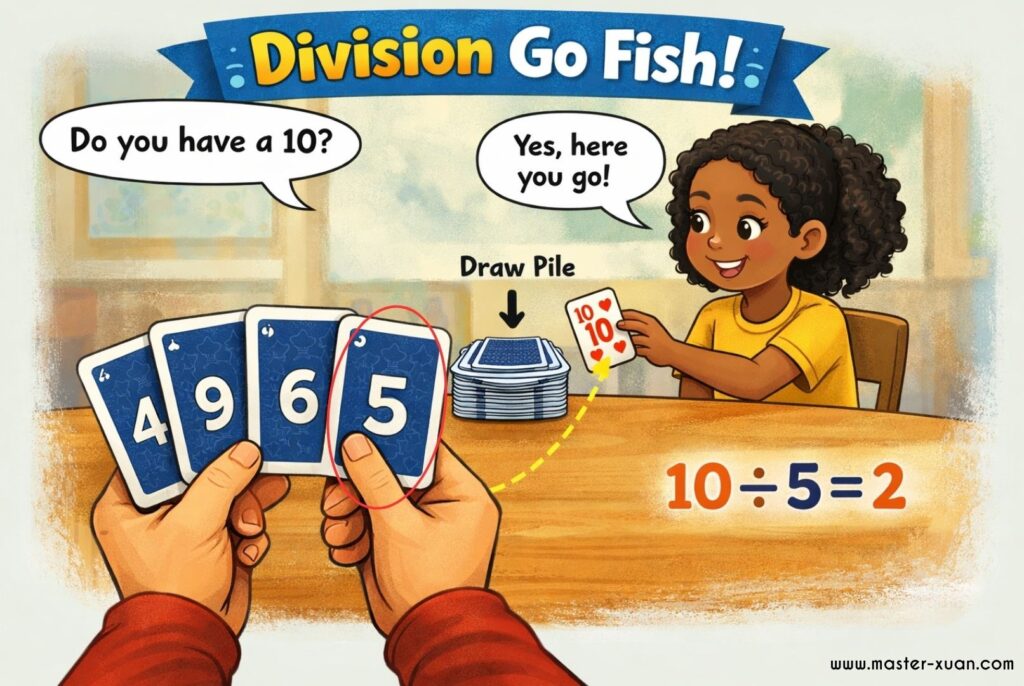
- The player then asks one other player for a specific card they need to complete their set.
Example: You have a 5. You know that 10/5 = 2 is a possible equation. You would ask another player, “Do you have a 10?”
3. Giving the Card (Success!)
- If the asked player has the requested card, they must hand it over to the asking player.
- The asking player now has a complete set. They lay the two cards down on the table, face-up, and get to take another turn immediately.
4. “Go Fish!” (Draw a Card)
- If the asked player does not have the requested card, they say, “Go Fish!”
- The asking player draws the top card from the Draw Pile.
- If the card drawn completes a set (either with a card they already have or with the card they just asked for), they lay the set down immediately.
- The turn ends and passes to the next player clockwise.
5. Running Out of Cards
- If a player lays down their last set of cards and has no cards left in their hand, they immediately draw 5 new cards from the Draw Pile.
Winning the Game
The game can end in one of two ways:
- The Draw Pile is Empty: Once the Draw Pile is exhausted, players continue asking for cards.
- Stalemate: The game officially ends when the Draw Pile is empty and three consecutive turns have passed where no player successfully got a card from another player (only “Go Fish” was said, but the player couldn’t draw a card).
The Winner
- The player who has collected the most complete division number sentences (sets of two cards) is the winner!
Division Memory Match (Concentration Style)
This is the ultimate test of division knowledge and visual memory! All cards are face-down, forcing students to recall the location of potential divisors and dividends turned over by other players.
Game Setup
- Players: 2 to 4 students.
- Deck: Standard deck of cards (remove J, Q, K, and Jokers).
- Value: Ace = 1, all number cards (2 through 10) hold their face value.
- Goal: Collect the most complete division number sentences (sets of two cards).
- Layout: Shuffle all the cards and place them face-down on the playing surface in a grid formation (e.g., 4 rows by 5 columns or 6 rows by 3 columns).
- No Hand: Players start with no cards in their hand.
How to Play
1. The Flip
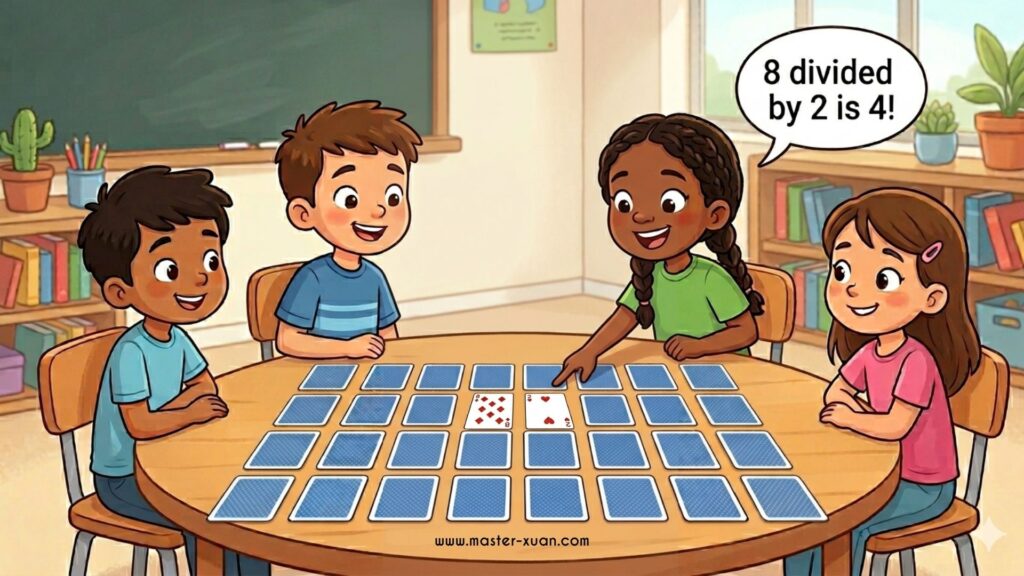
- Player 1 begins the turn by flipping over any two cards from the grid, leaving them face-up for all players to see.
2. Check for a Division Match
- The player looks at the two revealed cards and determines if they can be used to form a division number sentence where the division is even (no remainder).
- Example: Player 1 flips a 10 and a 2. They announce: “10 divided by 2 is 5!”
3. Successful Match (Take the Cards)
- If the two cards form a valid, even division equation:
- The player keeps the two cards and places them in their scoring pile (their collected sets).
- The player takes another turn immediately.
4. No Match (The Memory Challenge)
- If the two cards do not form a valid division equation:
- The player must turn both cards face-down exactly where they were located.
- Crucially: All players must try to remember the identity and location of those two cards, as they may need them on a future turn.
- The turn ends and passes to the next player clockwise.
Winning the Game
- The game ends when all the cards have been successfully matched and removed from the playing surface.
- The player who has collected the most complete division number sentences (sets of two cards) is the winner!
Division Factor Set Builder
This division card games encourages students to analyze numbers for common divisors (factors) and collaborate by checking each other’s work.
Game Setup
- Players: 2 to 4 students (works well collaboratively or competitively).
- Deck: Standard deck of cards (remove all J, Q, K, and Jokers).
- Value: Ace = 1, cards 2 through 10 hold their face value.
- Goal: Collect the most Dividend cards by correctly identifying a common divisor for any number of cards on the Board.
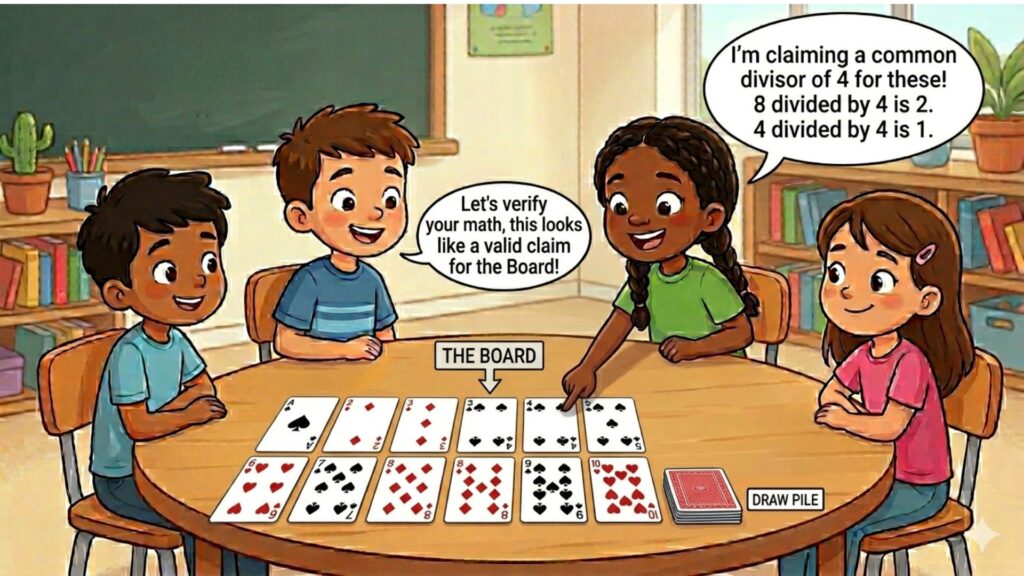
- Layout: Deal 10 cards face-up onto the table in a two-row by five-column grid. This is the Board. The rest of the deck is the Draw Pile.
How to Play
1. The Strategy (Player’s Choice)
- Player 1 begins their turn by looking at the 10 cards on the Board.
- They choose a Divisor Number (e.g., 2, 3, 4, 5, etc.) that they believe divides at least one of the cards on the Board evenly.
- Player 1 announces: “I am claiming the common divisor [Chosen Number].”
2. The Claim and Proof
- The player then points to all cards on the Board that can be divided evenly by their chosen Divisor (this could be one card, two cards, or ten cards).
- They must then prove their claim by stating the division equation and the quotient for each card they claimed.
- Example: Player 1 claims the divisor 4.
- They point to an 8 and a 4 on the Board.
- They state: “8 divided by 4 is 2. 4 divided by 4 is 1.“
3. Verification (Interaction)
- The other players are responsible for checking the math. This is the core interactive, low-speed component:
- If the math is correct, Player 1 is successful.
- If the math is incorrect (e.g., they claimed a 7 could be divided by 3 evenly), their turn ends immediately, and no cards are collected.
4. Collect and Refill
- If successful, Player 1 collects the Dividend cards (8 and 4) and places them in their scoring pile.
- The empty spots on the Board are immediately refilled from the Draw Pile, and the turn passes clockwise.
Winning the Game
- The player who has collected the most individual cards is the winner!
Conclusion
You now have three powerful, engaging tools to make division practice fun, interactive, and strategic. Forget the endless, stressful repetition of flashcards; these division card games turn math facts into an exciting challenge of memory, factor analysis, and quick thinking.
Whether you’re looking for a low-key division card games to practice division pairs (Division Go Fish), a fast-paced memory challenge (Memory Match), or a deep strategy session on common factors (Factor Set Builder), your standard deck of cards is now your most versatile teaching aid.
Gather your players, remove those face cards, and watch as your students and children move past memorization and into true division mastery. Happy dividing!
If you want other division game review, check out my TPT store for more!
Related Read: 5 Easy Math Card Games Students Will Love To Play
Here are some pins that you can save to bookmark this post. Save them to your Pinterest Board now! ↓